
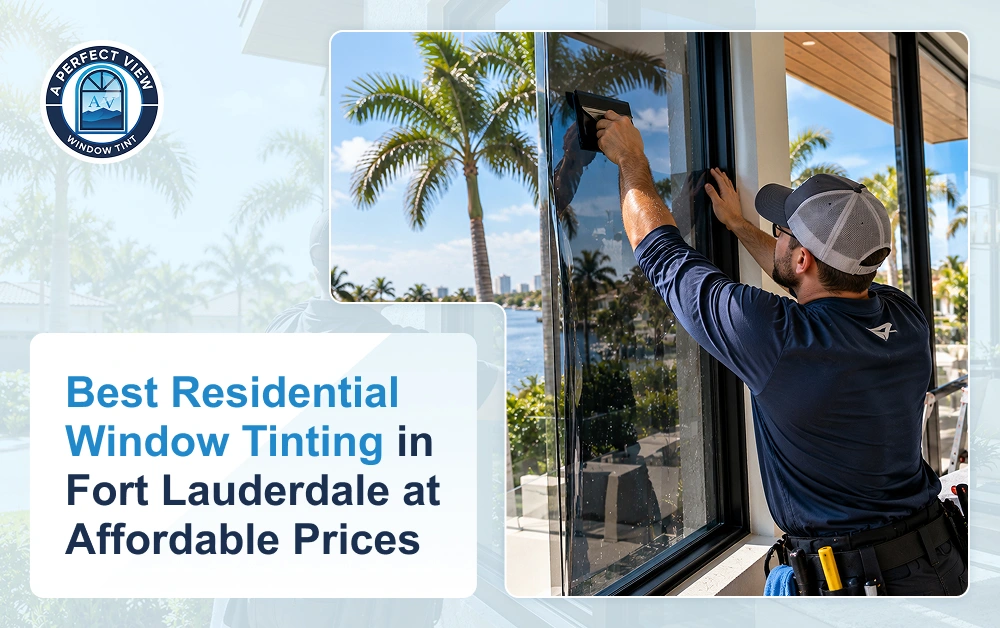
Fort Lauderdale gets an average UV index of 9 during summer months. That’s ‘very high’ on the scale, which means unprotected skin burns can happen in under 15 minutes. Now think about what that same sun does to your furniture, your floors, and your AC bill.
Your windows are one of the biggest entry points for that intense sunlight and heat. Only good residential window tinting can help you. It can lower the heat from the sun and UV exposure and help to make your home more comfortable.
In this blog, we will explain how much does it cost for a residential window tinting Fort Lauderdale project, what determines the cost, and how you can save money through it.
How Much Does It Cost for Residential Window Tinting Fort Lauderdale?
Residential window tinting in Fort Lauderdale generally costs between $5 to $15 per square foot, depending on the film and installation. Cost will vary depending on the material.
- Basic dyed film: About $8 per square foot installed. Blocks heat and UV but fades quicker. It’s a budget option.
- Carbon film: Around $10 per square foot. Non-metallic, no signal interference, solid performance. The sweet spot for most folks.
- Ceramic film: Roughly $13 per square foot. Highest heat rejection with longest lifespan, but costs more.
- Security film: About $15 per square foot. Holds glass together after impact.
Commercial window tinting Fort Lauderdale pricing is similar in structure but scales with building size. Larger projects receive better rates per square foot because the setup costs are spread out more.
Factors That Determine the Price of Residential Window Tinting Fort Lauderdale
Window tinting prices depend on several variables, including the type of film, number of windows, window size, accessibility, and whether old film needs to be removed. Let’s have a closer look at them:
1. Type of Window Film
Film technology is one of the biggest price determinants:
- Dye film is generally the least expensive option. It could improve privacy and reduce glare, but its solar performance might be less than that of more advanced products.
- Metallized film uses metallic particles that reflect the sun’s energy. It may be more reflective and may interfere with some electronic signals, but it provides more heat rejection.
- Ceramic film with nonmetallic ceramic particles gives good solar control with visibility and no signal interference.
2. Window Size and Glass Area
The more glass you have, the more film is needed.
Plus, larger sheets may require additional work or special installation techniques to get the film in place without contamination or creasing.
3. Style of Windows and Accessibility
Work on a rectangular window on the ground floor is reasonably simple.
A tall window over a stairwell? Gets tougher.
Unusual shapes like bay windows, skylights and French doors can also result in higher labour costs, as installers have to spend more time measuring, cutting, positioning and finishing each piece of glass.
4. Existing Film Removal
Have old tint already?
Before you get a quote, tell the installer.
Old film can have adhesive that has dried out over the years. It can be a lot longer to get it off cleanly than to put new film onto bare glass. Older films can also leave an adhesive residue that needs extra cleaning before the new film can be applied.
5. Solar Performance You Want
Is privacy your main concern? Less glare? Or UV protection?
Each is a different specification.
Mostly, solar control might be more of a priority for residential window tinting Boynton Beach projects.
For that, view specs such as:
- Visible Light Transmission (VLT): The amount of visible light that passes through
- Solar Heat Gain Coefficient (SHGC): How much solar heat passes through the window.
- Total Solar Energy Rejected (TSER): The percentage of solar energy that is rejected by the film.
- UV rejection: How well the film blocks ultraviolet radiation.
How Can a Residential Window Tinting Fort Lauderdale Project Save You Money?
Check out how we can help you save money in the long-run:
- Ceramic film from us blocks up to 99% of UV rays. That protects your furniture, hardwood floors, and artwork from costly replacements due to fading.
- An Oak Ridge National Laboratory (ORNL) study validated that utilizing rated solar control window films can cut heating and cooling energy demands by up to 24% compared to standard window baselines.
- You can reduce the need for heavy window coverings as solar control film can reduce glare.
Conclusion
The sun in Fort Lauderdale is really harsh. Your windows either block the heat or they let it pour in. Window tinting is one of those upgrades that pays you back quietly every single month. But, the material and installation quality dictate your savings
So, pick a trusted residential window tinting Fort Lauderdale company that shows you film specs, backs the work with a real warranty, and has been around long enough to fix problems if they arise.
A Perfect View Window brings 44 years of South Florida experience to every job. We know what works here because we’ve been doing it here for decades. Get a free quote now!
Frequently Asked Questions (FAQs)
1. What is the price of window tinting for a house in Fort Lauderdale?
On a typical house, you should expect to pay between approximately $5 and $15 per square foot, depending on the type of film, size of the window, how accessible the window is, if you need to remove old film, and the type of installation.
2. Is higher-priced window film always better?
Not necessarily. Compare the price with the film’s specifications, warranty, quality of installation, and the problem you are trying to solve.
3. Is ceramic window film worth the extra money?
If heat rejection, clarity, UV protection, and long term performance are priorities, it can be worth considering.
4. Will window tinting reduce my electricity bill?
It can cut down the solar heat coming in through the windows and thereby cut down the need for cooling. Savings, however, are highly variable from home to home.
5. What do we need to know before a commercial window tinting Fort Lauderdale project?
Commercial projects can involve much larger areas of glass, different needs, lift access, and more complicated conditions for installation. So one should not compare a commercial price directly to a residential quote.